
Healthcare is an inside job, but I occasionally make an appointment with my primary care physician to review basic blood work. We’re counseled to do this yearly, but I fudge a bit on that schedule since I know how to interpret many laboratory results and often order the tests myself. However, as the saying goes, “A doctor who treats himself has a fool for a patient.” Thus, I dutifully checked in with conventional biomedicine to see whether it had begun thinking holistically yet.
Because most of my conventional medical care takes place within Mercy Health System, I sent my primary care physician a message through MyChart asking him to order basic blood work ahead of my annual physical. This included a complete blood count, comprehensive metabolic panel, and lipid panel. Although I can order these tests myself—many people can now do so through direct-to-consumer sites—it is more convenient to have my blood drawn at a nearby Mercy facility. The results also appear in MyChart, along with helpful graphs illustrating trends, and sometimes insurance picks up the tab. I was right on the first two counts but dead wrong on the last.
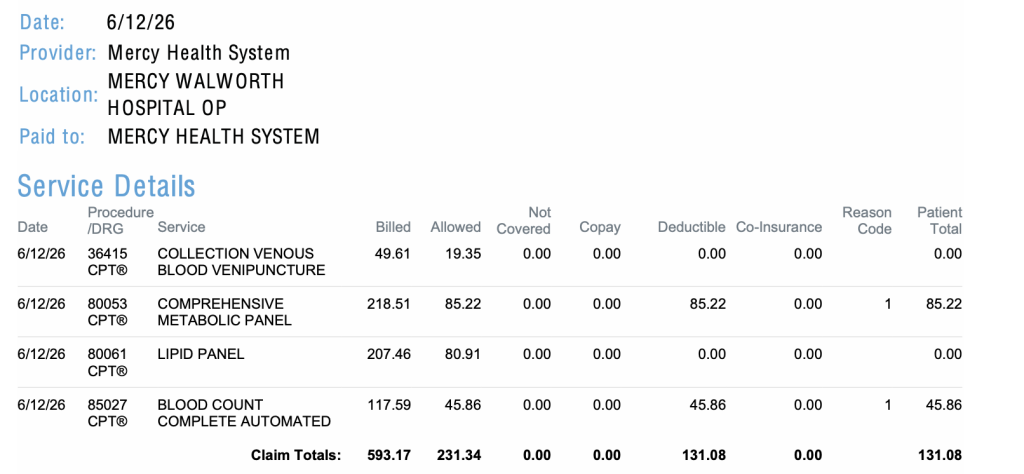
Imagine my shock when the Explanation of Benefits (EOB) arrived showing that I owed $131.08 after insurance. The lipid panel and blood draw left me with no patient responsibility, so that entire amount was for only the comprehensive metabolic panel and complete blood count. Mercy Health System billed $593.17 for the three tests and venipuncture. After the insurer’s negotiated discount, the allowed amount was still $231.34.
The calculation would have been different had I already met my deductible, but because this was my first use of insurance that year, the full $131.08 became my responsibility. I always carry a low-deductible plan through the healthcare exchange and have often reached my out-of-pocket maximum after receiving a single CT scan to monitor my cancer history. In years when healthcare expenses are blessedly quiet, however, we still face high costs for basic medical care on top of a monthly premium of more than $1,000 for just my wife and me.
How is this sustainable? How is the medical-industrial complex not bankrupting the American economy? The reality is that, for as much as we spend on healthcare, the United States does not enjoy commensurate health outcomes.
In 2024, U.S. healthcare spending rose to $5.3 trillion—$15,474 per person—and consumed 18 percent of the nation’s gross domestic product, according to the Centers for Medicare & Medicaid Services. A recent KFF comparison found that other large, wealthy countries spend about half as much per person. The difference does not appear to result from Americans using twice as much care. Comparative analyses indicate that healthcare utilization in the United States is generally lower than in peer nations and that higher prices are the primary driver of the spending gap. My $593.17 laboratory bill is a small but vivid example of a system in which the price of ordinary care can become untethered from its apparent cost or value.
Nor do our outcomes justify the premium. The Organisation for Economic Co-operation and Development reports that US life expectancy is 78.4 years—2.7 years below the OECD average. Both preventable and treatable mortality are also substantially higher here. Similarly, the Commonwealth Fund ranked the United States last overall among ten wealthy nations in its most recent comparison of healthcare access, equity, administrative efficiency, and outcomes. We are not merely paying more; we are paying more within a fragmented system that frequently makes basic care harder to access, understand, and afford.
For comparison, if I order the same three tests from Quest or Access Medical Labs, the total cost of testing is $16.25 or $16.10, respectively. Because these are patient-pay services, there is also a draw fee that varies depending on the phlebotomy site, but it is generally less than $20. Altogether, you are usually looking at less than $40 for basic blood work—less than one-tenth of the insurance-billed charges shown on my EOB.
There are downsides to this approach. If you live in a rural area, you might have to drive to a larger city to access a draw center. Although the results will not automatically appear in MyChart, you can ask your doctor or nurse to scan them into your medical record.
It does not always make sense to obtain laboratory testing through patient-pay portals, but the option is worth considering when the cost is a fraction of what would otherwise be billed to insurance. This is especially true when ordering a panel of tests that allows an integrative provider to gather a broad array of health metrics that can collectively guide preventive strategies. More is not always better, but broader testing can sometimes be helpful when you do not know what you do not know.
For example, I offer a $90 panel that includes 63 biomarkers (opens in new tab), casting a wide net across cardiovascular, metabolic, hormonal, and nutritional metrics to provide a comprehensive health assessment. Obtaining such a big-picture view can be financially impractical within a conventional medical clinic, particularly when each component is billed separately.
None of this means that everyone should become their own physician. Laboratory values are measurements, not diagnoses. An abnormal result must be interpreted in the context of symptoms, medical history, medications, trends, and other findings. Ordering tests indiscriminately can also produce incidental abnormalities that generate anxiety or lead to unnecessary follow-up. Patient-directed testing works best when it is used thoughtfully and, when appropriate, reviewed with a qualified healthcare professional.
But patients can become more informed purchasers of their own medical care. Before undergoing routine blood work, ask what tests are being ordered, whether they are likely to be covered, what the estimated patient responsibility will be, and whether a cash-pay alternative is available. Compare the hospital laboratory’s price with those of independent laboratories and patient-pay services. The few minutes required to investigate your options could save hundreds of dollars.
Healthcare may be an inside job, but navigating the healthcare system requires looking outward at how prices are constructed and who ultimately pays them. When the same basic tests can cost less than $40 in one setting yet generate nearly $600 in billed charges in another, price transparency becomes part of health literacy. We cannot individually repair the medical-industrial complex, but we can refuse to move blindly through it. Ordering selected blood tests ourselves—and obtaining professional guidance when the results warrant it—is one practical way to reclaim agency, reduce waste, and direct more of our resources toward maintaining health rather than financing bureaucracy.
References
Blumenthal, David, Evan D. Gumas, Arnav Shah, Munira Z. Gunja, and Reginald D. Williams II. Mirror, Mirror 2024: A Portrait of the Failing U.S. Health System—Comparing Performance in 10 Nations. New York: Commonwealth Fund, September 19, 2024. https://doi.org/10.26099/ta0g-zp66 (opens in new tab).
Centers for Medicare & Medicaid Services. “National Health Expenditure Data: Historical.” Last modified January 14, 2026. https://www.cms.gov/data-research/statistics-trends-and-reports/national-health-expenditure-data/historical (opens in new tab).
Organisation for Economic Co-operation and Development. “Health at a Glance 2025: United States.” In Health at a Glance 2025: OECD Indicators. Paris: OECD Publishing, 2025. https://www.oecd.org/en/publications/health-at-a-glance-2025_15a55280-en/united-states_3517f35e-en.html (opens in new tab).
Tevis, Delaney, Matt McGough, Juliette Cubanski, Matthew Rae, and Cynthia Cox. “How Do Health Care Prices and Utilization in the United States Compare to Peer Nations?” Peterson–KFF Health System Tracker, September 4, 2025. https://www.kff.org/health-costs/how-do-healthcare-prices-and-use-in-the-u-s-compare-to-other-countries/ (opens in new tab).