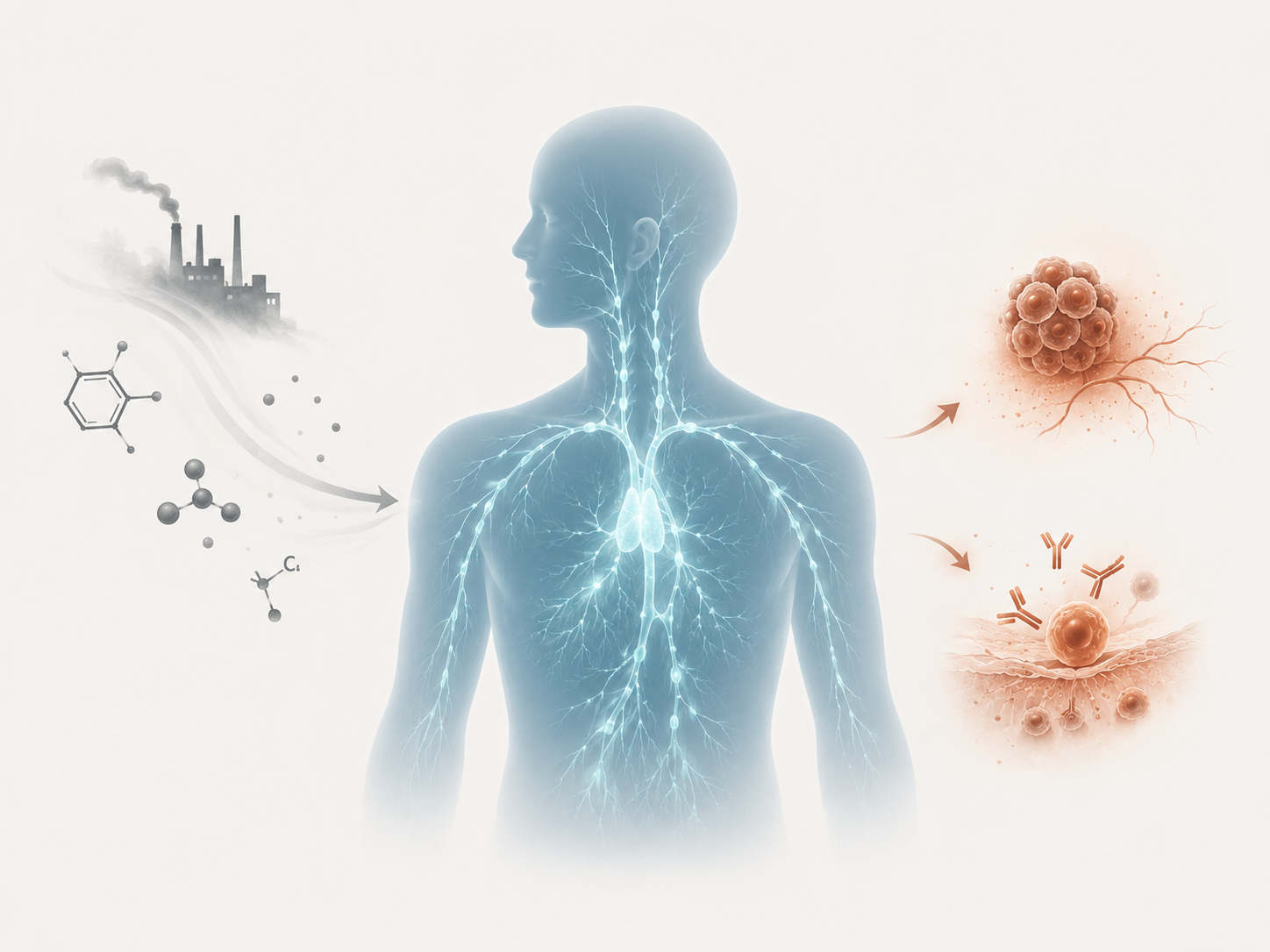
Every so often, I come across a technical document that deserves a wider audience. Not because it is easy reading, but because it quietly confirms something many patients and practitioners have been circling around for years: chemical exposure is not only a question of poisoning, cancer, or organ damage. It is also a question of immune competence.
The document I am referring to is a 2012 guidance paper from the World Health Organization and the International Programme on Chemical Safety titled Guidance for Immunotoxicity Risk Assessment for Chemicals (opens in new tab). It is not a sensational document. It is sober, technical, and written for risk assessors. But that is exactly what makes it valuable. One of the most important lines in the document is this: “Immunotoxicity is a non-cancer end-point comparable to other types of potential systemic toxicity considered in a general risk assessment.”
That sentence means that immune disruption from chemical exposure is not fringe speculation. It is not merely an alternative-health concern. It is recognized as a legitimate category of toxicological harm. A chemical does not need to be formally classified as a carcinogen in order to be biologically relevant to cancer risk, chronic illness, allergy, autoimmunity, infection susceptibility, or inflammatory disease. If it impairs the immune system, overstimulates it, dysregulates it, or contributes to loss of tolerance, then it has altered the terrain in which disease either develops or is held in check.
Cancer is often discussed as though it is only a problem of damaged DNA. That is one part of the story, but it is not the whole story. The body is constantly identifying and removing abnormal cells. Immune surveillance is one of the reasons not every abnormal cell becomes a tumor. Natural killer cells, cytotoxic T cells, macrophages, dendritic cells, cytokine signaling, inflammatory balance, and tissue microenvironments all participate in the ongoing decision between containment and disease progression.
So even when a chemical is not presented as a direct carcinogen, we still have to ask: What does it do to immune surveillance? If a xenobiotic suppresses natural killer cell activity, weakens response to infectious challenge, disrupts cytokine balance, inflames tissue, alters antigen presentation, or confuses self/non-self recognition, it may not “cause cancer” in the simple one-chemical, one-disease sense. But it may help create the conditions in which malignancy is more likely to emerge, persist, or evade detection. This is the terrain argument.
Terrain theory, properly understood, does not require us to reject modern pathology or molecular biology. It asks us to widen the lens. The question is not only, “What agent caused this disease?” The question is also, “What condition was the host in when the insult occurred?”
- Was immune surveillance strong or compromised?
- Was inflammation resolving or chronic?
- Was detoxification capacity sufficient or overwhelmed?
- Was the microbiome resilient or disrupted?
- Was the person exposed to one chemical or many?
- Was exposure acute, chronic, prenatal, occupational, dietary, inhaled, dermal, or all of the above?
- Was the individual genetically, nutritionally, hormonally, or developmentally more vulnerable?
This is where the modern concept of the exposome becomes so useful. The exposome refers to the totality of exposures a person experiences across life, along with the body’s biological response to those exposures. This includes chemicals, pollutants, diet, infections, medications, stress physiology, lifestyle factors, occupational exposures, indoor air, water quality, and the internal metabolic consequences of all of the above. In other words, the exposome gives scientific language to what terrain-minded practitioners have long emphasized: the body is not exposed to one thing at a time.
This is one of the major weaknesses in many epidemiological studies. The WHO/IPCS document acknowledges that human epidemiology often lacks precise exposure information and may not adequately control for confounding variables. That is not a small limitation; it is central to the problem.
The average person is not exposed to a single chemical in a laboratory chamber. We live in a mixture. We inhale, ingest, absorb, metabolize, store, and excrete dozens—often hundreds—of xenobiotic compounds across time. Some are persistent. Some bioaccumulate. Some act briefly but repeatedly. Some are harmless at one dose and disruptive at another. Some may be more dangerous during pregnancy, infancy, puberty, illness, immune activation, or aging. Some may matter most not by what they do alone, but by how they interact with other exposures and the individual’s biology.
This is why “the evidence is inconclusive” can sometimes mean something very different from “there is no problem.” If exposure assessment is poor, if mixtures are not accounted for, if immune endpoints are too crude, if the wrong window of vulnerability is studied, or if individual susceptibility is ignored, then the study may fail to detect harm that is still biologically plausible and clinically meaningful.
The WHO/IPCS document makes another point that deserves attention: the resting immune system may not be enough to evaluate immune health. Immune dysfunction may only become visible under challenge. In other words, a person’s immune system may look acceptable on routine markers until it is asked to respond—to a vaccine, an infection, a tumor cell, an allergen, a tissue injury, or a chronic inflammatory trigger. This has obvious implications for chronic illness.
Many people with recalcitrant health problems are told that their basic labs are normal. Yet their lived experience suggests poor resilience: they flare easily, recover slowly, react unpredictably, develop sensitivities, experience chronic inflammation, or seem unable to resolve infections, injuries, or immune provocations. A terrain-based model does not dismiss these patients because the first layer of testing is unrevealing. It asks whether the wrong layer of function is being measured. This is especially relevant to autoimmunity.
Autoimmune disease represents a failure of immune tolerance. The immune system begins reacting against self-tissue, or against tissue that has been chemically altered, damaged, inflamed, or made to appear foreign. The WHO/IPCS document treats autoimmunity as one of the major categories of immunotoxic risk, alongside immunosuppression, immunostimulation, and allergic sensitization.
Chemical exposure may contribute to disease not only by weakening immunity, but also by misdirecting it. From a terrain perspective, cancer and autoimmunity can be seen as two different forms of immune failure. In cancer, the immune system may fail to adequately detect or eliminate abnormal cells. In autoimmunity, the immune system may become overactive or misdirected against the body’s own tissues. One is too little recognition where recognition is needed. The other is too much recognition where tolerance is needed. Both can emerge from immune dysregulation.
This does not mean every case of cancer or autoimmunity is caused by chemical exposure. It does not mean every exposure is dangerous. It does not mean we should live in fear of the modern world. But it does mean our model of chronic disease must become more ecologically sophisticated.
We need to move beyond the overly narrow question, “Is this chemical a proven carcinogen?” and ask broader questions:
- Does it impair immune surveillance?
- Does it suppress natural killer cell activity?
- Does it alter antibody response?
- Does it increase inflammatory signaling?
- Does it promote sensitization or allergy?
- Does it contribute to loss of tolerance?
- Does it affect the developing immune system?
- Does it bioaccumulate?
- Does it interact with other exposures?
- Does it matter more in susceptible people than in the statistical average?
The deeper lesson here is that immune function is not a side issue in environmental medicine—it is central. The immune system is one of the body’s major interfaces with the environment. It samples the world, interprets threat, maintains tolerance, coordinates repair, restrains infection, monitors abnormal cells, and helps determine whether inflammation resolves or becomes chronic.
When xenobiotic exposure disrupts that system, the consequences may be broad. They may include infections, allergies, inflammatory disorders, autoimmunity, poor vaccine response, impaired tumor surveillance, and altered resilience across the lifespan. This is the bridge between environmental toxicology and chronic illness. It is also the bridge between modern exposome science and the older language of terrain.
The terrain is not mystical. It is the sum of biological conditions that determine how a person responds to exposure. Genetics matter. Nutrition matters. The microbiome matters. Mitochondrial function matters. Detoxification capacity matters. Stress physiology matters. Developmental timing matters. Prior illness matters. Chemical mixtures matter. And immune competence may be one of the central determinants of whether the body adapts, compensates, flares, or progresses into disease.
The WHO/IPCS document is technical, but it is worth skimming even if you do not read every page. Pay special attention to the framing: immunotoxicity is a recognized endpoint of chemical risk assessment. That alone should change how we think about environmental health. The question is not only whether a chemical kills cells, mutates DNA, or causes cancer directly. The question is whether it changes the terrain in which cancer, autoimmunity, allergy, inflammation, and chronic illness become more likely.