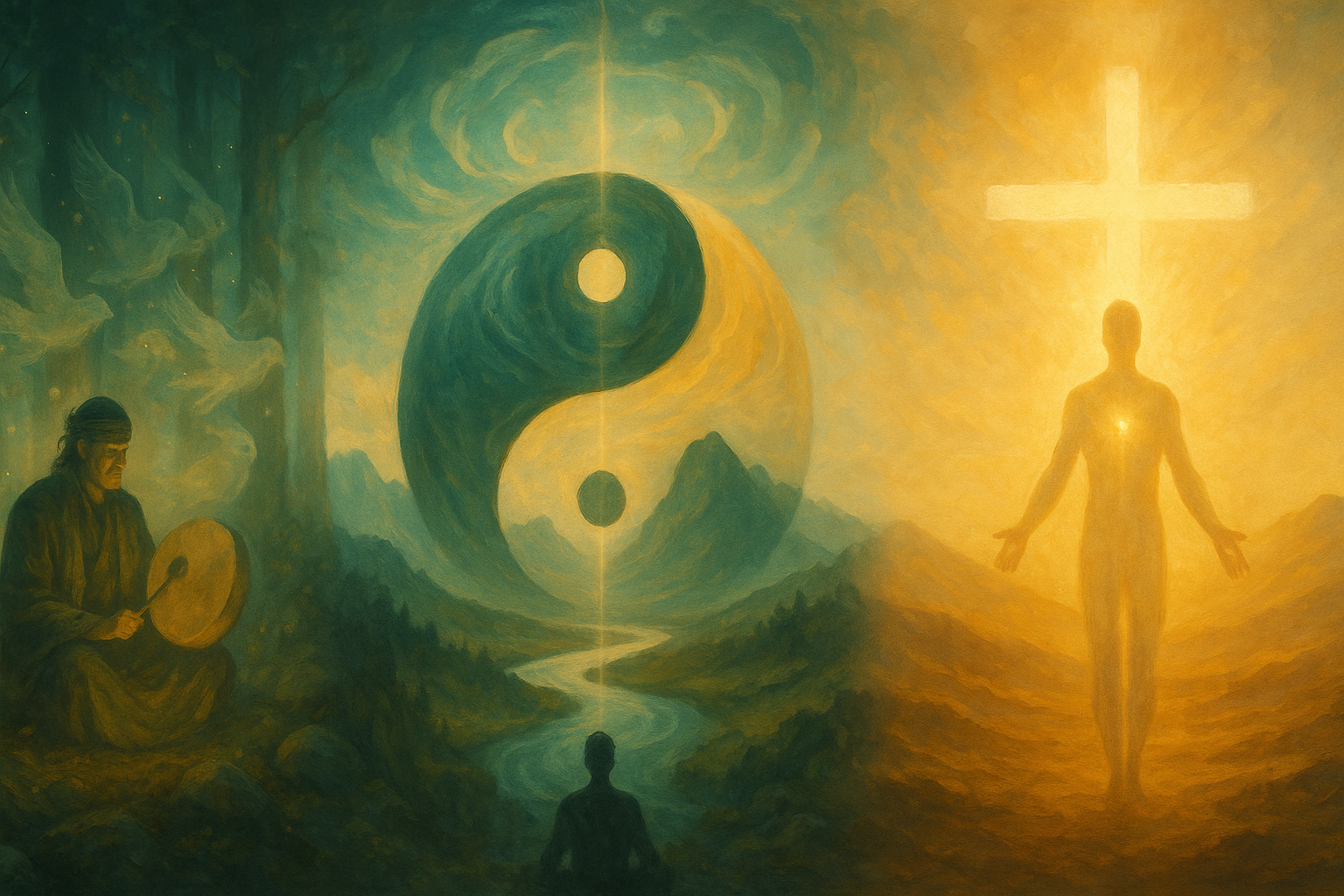
The foundation is set. If you’ve been following this blog series, you now have a firm grasp of spiritual medicine—beginning with consciousness as spirit and appreciating the subtle interplay of body, mind, and emotions as expressions of our spiritual nature. Now we need to qualify the notion that at the root of all healing is alignment with our spiritual purpose. To do that, we’ll look at three spiritual traditions—shamanism, Taoism, and gnostic Christianity—to map how misalignment happens and how harmony can be restored.
Shamanism: Power, Soul, and Intrusion
The oldest of the three, shamanism, rests on an animist worldview (all of nature is alive and conscious—yes, even rocks). Its rituals and practices have guided indigenous peoples for millennia. In many cases, shamanism evolves into organized religion; for example, Tibet’s Bön tradition matured into Mahayana Tibetan Buddhism.
At the heart of shamanism is the understanding that a spiritual dimension creates and interpenetrates the observable universe. When trained shamans enter a trance to communicate with spirit, they step into a non‑ordinary reality—an unseen dimension—where they can interact with deceased ancestors and nature spirits to divine wisdom and initiate healing.
Anthropologist Michael Harner codified the core tenets of shamanism that fueled its modern renaissance. He identified three main causes of spiritual illness:
1. Loss of personal power or life purpose.
Disconnection from nature and our true self drains vitality. The remedy is reconnection—linking the ill individual with protective nature or ancestral spirits who, through intuition, guide one back onto the spiritual path.
2. Soul loss.
This often stems from the dissociation that accompanies individual or collective trauma. If power loss is a disconnect from nature, soul loss is a disconnect from oneself. The former tends to underlie anxiety and indolence; the latter often manifests as depression and addiction.
3. Intrusion.
Here, some other energy negatively affects your own. It goes by many names—cord, curse, possession—depending on cultural context. The remedy is extraction or depossession of the afflicting energy, coupled with reinforcement of healthy boundaries and personal power. This may include “homework”: exercises to restore agency, because even though shamanism can help remove what clings to a person, the person must also let go of what they cling to.
Taoism & TCM: Yin–Yang and the Five Spirits
The next tradition in this matrix is Taoism and its great inheritor, traditional Chinese medicine (TCM). We’ve already explored the five spirits that inhabit the body and how suppressing or repressing emotions seeds illness. But what causes emotional disharmony in the first place?
Taoist-informed TCM teaches that humans are a balance of heaven and earth—an amalgam of yin and yang, the quintessential polarity of interdependent opposites. Disease arises from falling out of rhythm with nature. That could mean going against our biological wiring—say, sleeping only four hours a night—but it also implies spiritual misalignment. In this way, early Taoist thought accords with the shamanic worldview.
Like shamanic work, TCM often frames illness along a polarity: deficiency of qi (akin to power loss), stagnation of qi (akin to intrusion), and, classically, even recognizes and treats forms of possession.
Gnostic Christianity: The Wound as the Way
Gnostic Christianity is a third tradition that views spiritual alignment as the highest medicine. Thousands of Christian denominations debate theology, but beyond orthodoxy lies a philosophical middle ground that honors the body’s physicality while offering a path of transcendence.
Central to that path is the notion that the wound is the way. For those who see Jesus as God fully incarnate, his pain reminds us that suffering will visit us all—but it can lead us back to God and our spiritual nature. After the resurrection, Jesus is made whole, yet his light body still bears the wounds of his earthly trials.
Convergences Across Traditions
These traditions share much. Jesus’s healing ministry is profoundly shamanic—from casting out demons, to fasting in the desert, to the transfiguration. Several scholarly works explore Jesus as a paragon of shamanic practice.
Likewise, the Taoist sage Lao Tzu—purported author of the Tao Te Ching during the late Zhou dynasty—speaks a language that, centuries later and on another continent, resonates with the sayings of Jesus recorded in the New Testament. (For an intriguing read, see Aronson’s Jesus and Lao Tzu: The Parallel Sayings (opens in new tab).)
Grounding spiritual medicine in these historical contexts is interesting, but more importantly, it highlights the universality of the concepts presented here. Across cultures and eras—from indigenous communities to modernity—the spiritual dimension remains essential to medicine. In the next post, we’ll explore what modern science can offer to explain how and why these spiritual healing modalities are effective.