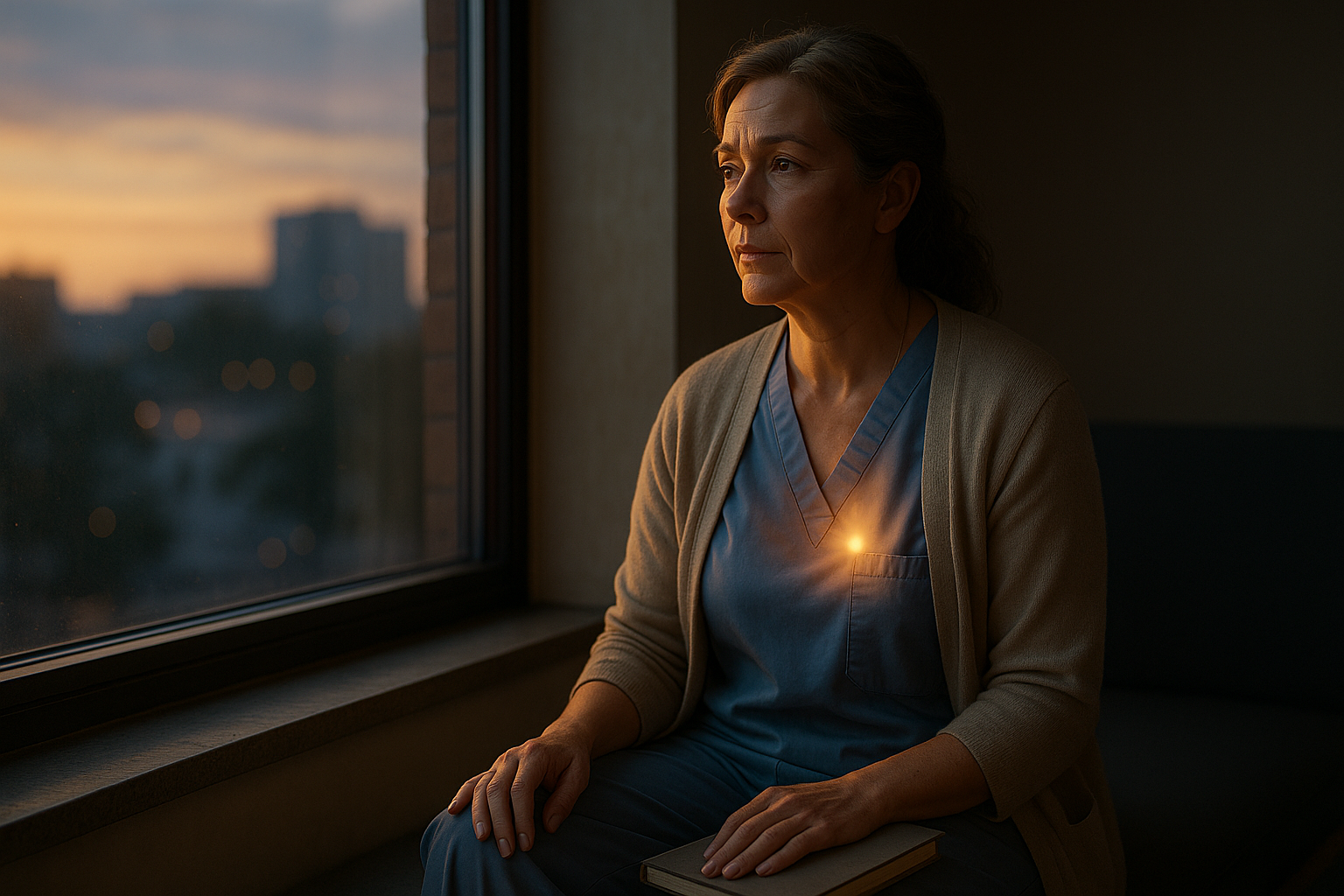
We’ve come a long way in exploring the concept of spiritual medicine, so I thought it would be helpful to revisit the arc of the series with a theoretical case study.
Consider a middle-aged woman I’ll call Freya: she’s married with two kids, a teen and a pre-teen, and works full-time as a nurse in an inpatient hospital setting. Her job is high stress, and she occasionally has to work long overnight shifts. When Freya is on the floor, she juggles pages from patients (via the hospital communication badge she wears around her neck) and seemingly endless amounts of digital paperwork. She started smoking in college but quit when she became pregnant with her first child. Her childhood and adolescent home life was stable, but she has a history of sexual abuse in high school that she hasn’t disclosed to anyone except a select few close girlfriends.
Freya likes her job, but the long hours keep her from seeing her kids in their various activities. Although the relationship with her husband has strong roots, they have not had time to connect as a couple, often collapsing into bed for what always seems like not enough sleep. With time as limited as it is, the family eats takeout a few times a week. This mother of two has a first love: oil painting, which she rarely has time to do. She even wanted to go to design school, but with a full-ride scholarship to a nursing program, her family encouraged her to get a “real job” and pursue painting later in life.
In the last few years, our patient has noted symptoms of perimenopause, including gaining 15 pounds that no amount of treadmill time seems to take off. Freya has mild reflux and takes a prescription to help manage it. Two years ago, her father passed away from lung cancer at age 63. This was devastating; her dad was always her confidant and safe space. Recently, Freya felt a lump in her right breast, and upon testing, she was diagnosed with breast cancer.

Freya is completely hypothetical, but she represents an accurate composite of cases from patients I’ve worked with over the last 20 years. Let’s examine her story through the lens of holistic medicine, of which environmental medicine and spiritual medicine are aspects.
Starting with environmental exposures, our patient has a history of bisphenol exposure from drinking out of plastic water bottles and eating takeout in plastic containers. A known endocrine-disrupting toxicant implicated in breast cancer in experimental models, this exposure is compounded by another carcinogenic influence: electromagnetic field exposure from the wireless communication badge hanging around her neck that constantly emits radiofrequency waves into her chest. A history of smoking adds to Freya’s body burden.
Her lifestyle is not supportive of recovery, so the oxidative stress caused by these carcinogens is not being mitigated. Between elevated stress hormones, non-restorative sleep, and nutrient deficiencies from eating a standard American diet, Freya’s body has been at a disadvantage for years. On top of this, years of rotating night shifts have disrupted her circadian biology, and long-term shift work itself is now recognized as a carcinogenic influence.
Now recall everything we’ve learned about spiritual medicine for the last piece of the puzzle. Freya has chronic stress, which is eroding her resilience, but her story also holds three wounds at the level of the soul that have fundamentally changed how she perceives herself and the world. The most obvious is the sexual trauma that left the scar of believing the world is not a safe place. Although she has “moved on” from the series of incidents, her shame has prevented her from seeking professional help to heal from the trauma. As we’ve learned, suppression or repression is not healing.
The most subtle wound is the messaging Freya received from her family that her creative expression through painting is not practical and that she should seek gainful employment. It is one thing to hear this from naysayers; it is quite another to receive it from those you trust and love. Even with the best of intentions from her family, our patient did not actively pursue her life purpose, that which truly nourishes her soul. Theoretically, Freya could have been painting all along as a hobby, but, as is too often the case with “Mom syndrome,” she puts the needs of her family first.
The third wound is the death of her father, which started a cascade of grief. Most of the emotional upheaval stems from the loss of a loved one, but some of it was bottled-up grief from squelching her artistic self, riding the wave of her dominant grief as the floodgates opened. With unprocessed grief, the body starts to mirror our emotional state. (As we’ve learned, the body and mind are not separate entities.) With that mirroring, the chest tends to collapse, the breath becomes shallow, and the qi—our life force—stagnates.
Recall that grief is the emotion associated with the TCM Lung energetic, and that, with its close proximity to the breast tissue, stagnancy here sets the stage for the seed of disease to develop. But it’s not just about one trauma or any number of traumas; it is the gestalt of everything related to Freya’s wellbeing.
When I’m asked, “What causes cancer?” I always hear at least two interdependent questions. The main two are, “How do we get cancer?” and “Why do we get cancer?” Notice a few things. I change the wording of the question from a very generic, big-picture “what” to a more personal inquiry by asking how and why “we,” as people, contract illness. We must never forget that there are no incurable diseases, only incurable patients, and it is the job of medicine to understand all the physiological, psychological, social, cultural, and environmental reasons why, for instance, cancer rates are increasing overall and in younger people.
The other main philosophical shift that happens by delineating these two questions is that it creates an awareness around external and internal causes of how disease develops—the yin and yang of etiology. In the case of cancer, the external causes are the carcinogens we are exposed to and the internal is the terrain, a handy term that connotes all the factors underlying the resilience of the body: nutrient sufficiency, the robustness of the immune system and detoxification pathways, mindset, etc. Whereas lifestyle factors such as poor diet and stress erode resilience acutely, trauma lowers our resilience perpetually—until, that is, the trauma is addressed. Put another way, the question “How do we get cancer?” asks what we are eating (among other external factors), and “Why do we get cancer?” addresses what is eating us.
Environmental factors and trauma are two very big epigenetic levers. Both are essential parts of our theoretical patient’s story, and we can’t separate Freya’s carcinogenic exposure from her grief, trauma, and neglected creativity—all hindrances to the fullest expression of her Shen, her greater spiritual self.
It is tempting to ask: Had this patient been living an idealized life as a carefree painter and been resourced to cope with trauma, would she have developed cancer or any other illness, for that matter? Or, in the opposite direction, amidst ongoing stress and emotional turmoil, can cancer initiate without carcinogen exposure? We can’t know this, but my highly informed clinical intuition is that both are required—though perhaps not in equal measure. It is impossible to live in the modern world and not accrue toxins, both carcinogenic and emotional. Bisphenols, grief, and resentment all plant the seeds of illness in our body, and sitting in a sauna to depurate toxicants is just as valuable an anticancer strategy as therapies to heal the root of trauma.
Hopefully, it is now clear where spiritual medicine fits within a holistic understanding of disease and wellness. When illness strikes, we’re quick to make appointments with medical care providers, but what if we were equally invested in connecting with clergy, chaplains, and spiritual directors who are ready and willing to draw out our essential goodness? What if we sought a still, contemplative space within us to ask the big questions: What truly matters in life? Where am I being invited to forgive others and myself? How am I being called into relationship with the Divine?
These are not philosophical or theological questions meant only to be asked when we are dying; they are the root of understanding all the reasons life is worth living.