The last post in this series reviewed three traditional paradigms of spiritual illness, each thousands of years old. Their efficacy has been borne out over time, but just because a way of doing something has deep roots doesn’t mean the fruits are pertinent to today’s culture. As Western culture leads with the scientific method and values technological advancement, it’s helpful to place traditional methods within an evidence-based context (when possible and appropriate). Thankfully, we don’t need to look very far to find a scientific basis for altered states of consciousness and their downstream effects on health and wellness.
The mind–body is capable of remarkable insight when the brain shifts its dominant rhythms. Whereas normal alert consciousness tends to sit in the beta range (roughly 13–30 Hz), deeper states correlate with meditative and ecstatic modes of awareness. Our brains often move into the alpha range (8–12 Hz) with focused yet diffuse attention, as in many meditation practices.
Deeper still is the theta range (4–7 Hz), where dreaming occurs—and where visionary shamanic states are often described. Flow and hypnotic states are frequently associated with increased frontal theta and moderate alpha activity, though the exact pattern varies by person and task.
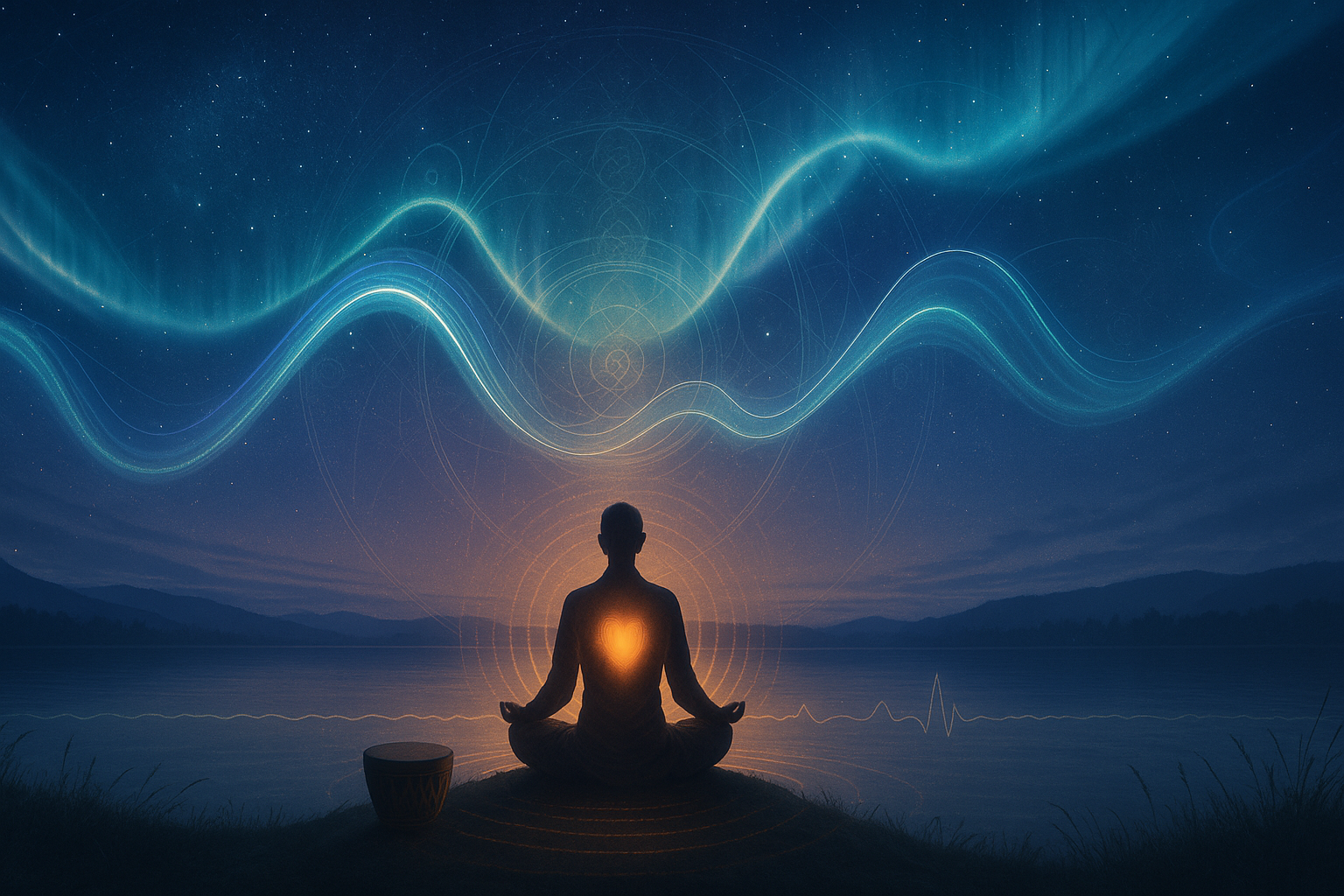
When I teach journeying, I relate the shamanic state to the ability to dream while awake, and research generally supports that connection. Rhythmic drumming near the theta range can facilitate a shift toward trance-like experience, helping us enter an ecstatic state in which we can influence the journey, seek guidance, ask questions, and receive answers and healing from a deep spiritual place.
As the brain accesses these deeper states, our physiology shifts as well. From the pioneering work of Dr. Herbert Benson on the relaxation response in meditation to neuroimaging studies showing reduced activity and altered connectivity in the brain’s default mode network among experienced meditators, the mystical has become measurable. One thing is clear from these correlations: the mind–body tends to heal when attention is focused and directed in deeper states of consciousness. The same is true during the delta range (about 0.5–3 Hz) of deep sleep—often called “restorative” sleep because it is associated with recovery and memory consolidation.
There is also a higher-frequency pattern that may be the calling card of our essential spiritual nature—what I’ve called the Heart-mind and what traditional Chinese medicine describes as the shen of the energetic Heart. This is the gamma band (commonly >30 Hz, sometimes reported up to ~100 Hz). Whereas the lower bands map onto aspects of conscious, subconscious, and unconscious processing, heightened gamma has been observed during advanced meditative practice and may reflect an integrated, highly engaged awareness. And although most of us aren’t saints, glimpses of the sublime during mystical experiences are more common than public discourse admits. For the less open-minded, these episodes are relegated to religious institutions—instead of being recognized as an innate human potential—or, worse, viewed as psychosis.
Notice I’ve been using the word correlation to describe brainwave frequencies and associated states. With a long history of brain-wave-entrainment meditation and shamanic drumming, I’m predisposed to think the frequency creates the state—but it’s equally possible that achieving the state shifts the frequency. Both are likely true. Various forms of entrainment can occur (for example, synchronizing with rhythmic auditory or visual stimulation), yet durable health effects still depend on practice, intention, and context. What we can assert is that altered states are achievable—and therefore spiritual healing is accessible—when we skillfully sync mind, body, breath, and rhythm.

This is also evident in heart–brain interaction. Decades of work on heart-rate variability (HRV) show that breath-paced practices and feeling gratitude can improve autonomic balance and mental state. How we think, what we feel, and how we breathe are levers that reliably shift awareness. HeartMath and other contributors in the HRV field have explored coherence between breathing, HRV, and attention, offering practical ways to cultivate steadier physiology and clearer perception. On this point, the sages and saints of prayer and meditation have been in agreement for millennia. And while genuine miracles are rare, most of us have access to intuitive wisdom—and increasing influence over our psychology and physiology—when we commit to the work.
When we view ancient practices through a modern lens, we don’t diminish their mystery—we discover the mechanisms that grant us access to spiritual healing. Breath slows, the heart steadies, attention gathers, and the brain’s rhythms reorganize. Whether through prayer, meditation, or the steady pulse of a drum, we learn to enter the doorway of altered state on purpose. From there, spiritual healing isn’t a rare exception reserved for saints; it’s a trainable human capacity—rooted in physiology, shaped by intention, and nourished by the Heart-mind we all carry.