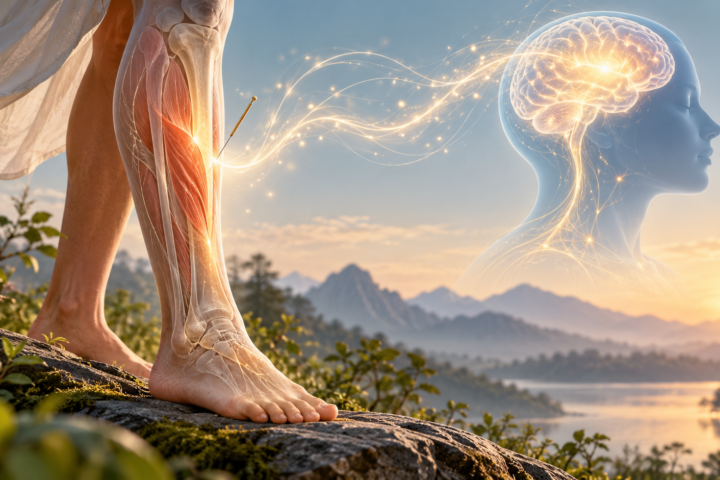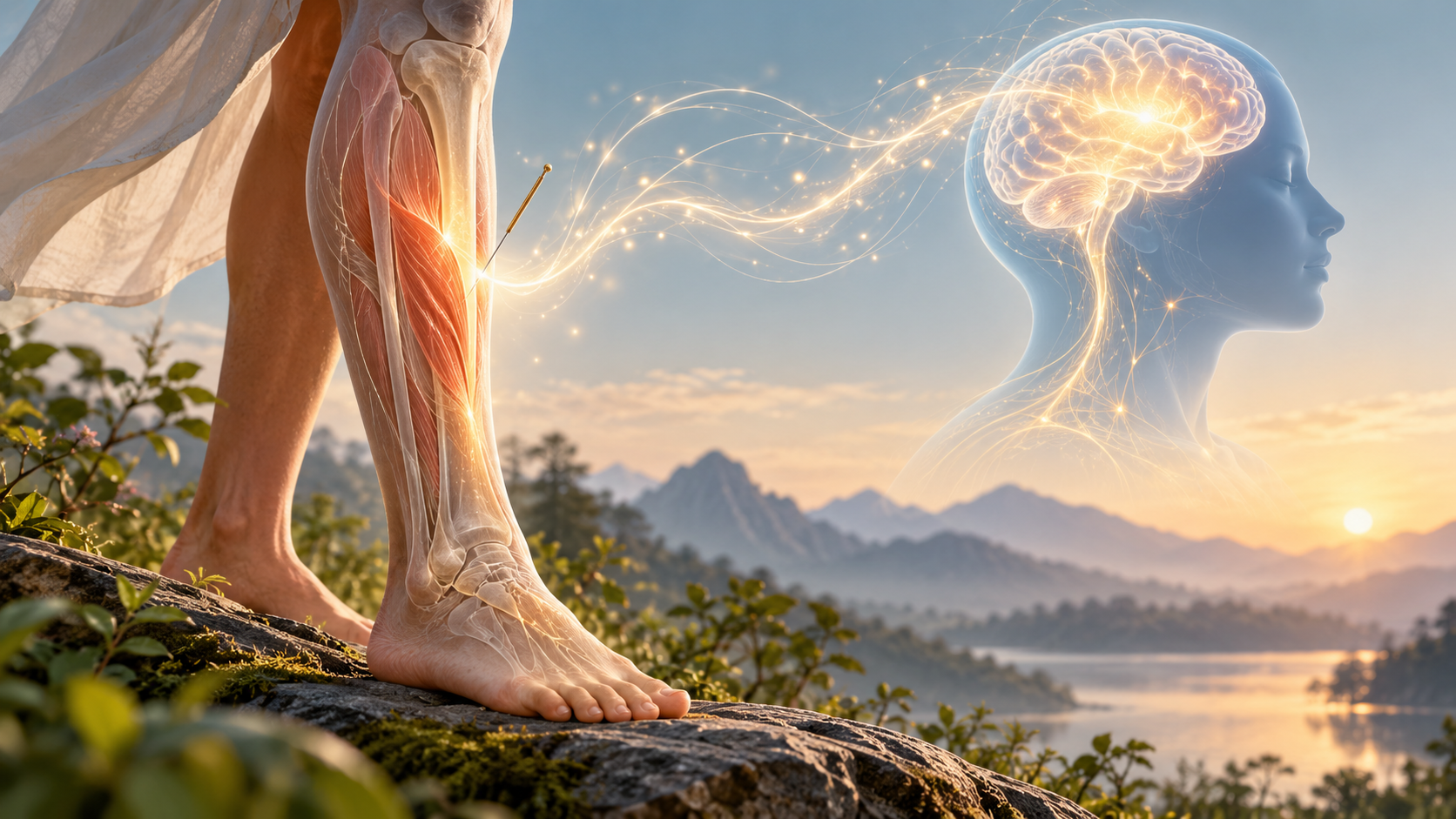
Every so often, a scientific study comes along that describes something in the language of modern physiology that feels strangely familiar from twenty years of practicing acupuncture. A new study published in Nature Neuroscience is one of those studies. Researchers found that mechanically compressing the tibia—the shinbone—could improve recovery from traumatic brain injury and stroke in animals by activating biological signals traveling from bone to brain.
When I first read about the research, my mind immediately went to one place: Stomach 36 (ST-36), one of the most important acupuncture points in the body. But the implications may reach farther than acupuncture or traumatic brain injury. The study touches on something I have explored extensively in my writing about trauma: experiences that happen to the body can alter the brain, and the brain remains capable of changing again in response to new experiences. What is particularly intriguing about this new research is the possibility that some of those restorative signals may originate from somewhere we rarely think of as communicative tissue—the skeleton itself.
The bone is more than scaffolding
The researchers began with an intriguing medical observation. People with traumatic brain injuries sometimes demonstrate accelerated bone healing or abnormal bone growth, suggesting that the injured brain somehow communicates with the skeleton. The investigators wondered whether that conversation might also travel in the opposite direction: could mechanically stimulating bone send signals back to the brain?
They tested this using repeated mechanical loading of the tibia in mice with traumatic brain injury or stroke. Animals receiving the treatment demonstrated better survival, motor recovery and cognitive performance, along with less neuronal loss and chronic inflammation. Importantly, the researchers also reproduced key findings in pigs with traumatic brain injury, making the work substantially more compelling than a mouse experiment alone.
The cellular biology is complicated, but the basic concept is surprisingly simple. Bone contains living cells called osteocytes that sense physical force. A mechanosensitive channel called PIEZO1 appears to help these cells recognize mechanical loading and convert that force into biochemical communication. When the researchers interfered with this sensing system, much of the brain-protective effect disappeared; when bone was mechanically stimulated, meanwhile, a variety of potentially restorative substances increased in the circulation.
Among them was brain-derived neurotrophic factor, better known as BDNF, a molecule deeply involved in the brain’s ability to remodel itself. Other anti-inflammatory and neuroprotective substances also increased, and serum taken from mechanically stimulated animals could reproduce some of the protective effects. The researchers therefore describe what they have discovered as a bone–brain axis: mechanical forces acting upon the skeleton can be translated into chemical signals capable of influencing the brain.
That is an extraordinary idea on its own. For an acupuncturist, however, the location makes it even more interesting.
ST-36: Leg Three Miles
ST-36 lies along the tibialis anterior muscle, immediately lateral to the tibia. Its Chinese name, Zusanli, is commonly translated as “Leg Three Miles,” referring to the traditional idea that stimulating the point could give an exhausted traveler enough strength to walk another three miles. I have always loved that imagery, and in the context of this research I can’t resist noticing another old expression: being bone tired.
After two decades of clinical practice, I can attest that ST-36 is a remarkable acupuncture point. Although acupuncture charts depict points as tiny dots, that is not how I experience ST-36 beneath my fingers or needle. It is a substantial functional region, roughly the size of a quarter in many people, and strong stimulation frequently produces a pronounced radiating sensation through the tibialis anterior and down the lower leg along what traditional Chinese medicine (TCM) identifies as the Stomach meridian.
ST-36 is also a motor point. Correct stimulation can engage that entire muscular region, and we commonly needle deeply enough that the needle is quite close to the tibia itself. I cannot begin to estimate how many times I have needled ST-36 over twenty years, but I can say that it is one of those acupuncture points whose physiological presence is difficult to dismiss once you have experienced it repeatedly in practice.
TCM adds another curious piece to the puzzle. Although the external Stomach meridian runs down the anterior leg, its internal pathway connects upward through the torso and head. That traditional map obviously cannot be equated with a modern anatomical bone–brain pathway, but the juxtaposition is difficult not to appreciate: one of acupuncture’s most powerful systemic points lies beside the tibia, produces substantial local mechanical stimulation, and belongs to a channel traditionally understood to communicate with the head.
There is another traditional correspondence worth noting. In TCM, the bones are associated with the Kidney system, while the brain is described as the “sea of marrow.” Marrow itself is traditionally understood as arising from Kidney essence, creating an ancient conceptual relationship between bone, marrow and brain. This should not be mistaken for a description of the molecular bone–brain axis uncovered by modern research, but the parallel is nevertheless striking: TCM has long treated the skeleton and brain as physiologically related rather than entirely separate structures.
The obvious question is whether acupuncture at ST-36 could stimulate anything resembling the newly discovered bone–brain response. At present, we do not know. The Nature Neuroscience researchers compressed the tibia mechanically; they did not perform acupuncture, and their findings should not be presented as evidence that acupuncture activates this pathway. Yet the discovery gives us a scientifically testable question that would have seemed considerably more speculative only a few years ago.
Acupuncture and an injured brain
The connection becomes still more provocative because acupuncture has already been studied in people recovering from mild traumatic brain injury. A randomized controlled trial published in Radiology in 2025 compared genuine acupuncture with sham acupuncture and a waiting-list control in 66 people experiencing postconcussion symptoms. Participants in the acupuncture group received 14 treatments over four weeks, with needles manipulated to elicit de qi and then electrically stimulated at 2 Hz.
One of the points in that treatment protocol was ST-36. Another was SP-6, located along the medial side of the tibia. The genuine acupuncture group experienced a significant reduction in postconcussion symptoms that persisted at six- to twelve-month follow-up, while MRI also demonstrated changes in white-matter integrity associated with the clinical improvement.
Once again, we should resist connecting dots that the researchers themselves did not test. The trial used multiple acupuncture points, and nobody measured osteocyte activity or asked whether bone signaling accounted for any of the improvement. Nevertheless, we now have one line of research showing that mechanical stimulation of the tibia can influence recovery in an injured brain, and another showing that an acupuncture treatment that included deep stimulation near the tibia produced both symptomatic and MRI changes in people with mild traumatic brain injury.
That is enough overlap to justify curiosity.
Trauma also changes the brain
This is where I think the story becomes bigger than traumatic brain injury. My own interest in trauma has focused extensively on emotional and psychological trauma, which should not be confused with a physical injury to brain tissue. Yet decades of neuroscience have demonstrated that sufficiently intense or prolonged traumatic experience can also leave measurable fingerprints on the brain.
Modern neuroimaging studies of post-traumatic stress disorder have repeatedly identified differences in brain regions and networks involved in memory, threat detection, emotional regulation and executive control. The hippocampus, amygdala, anterior cingulate cortex and prefrontal regions have all figured prominently in this literature, while newer research increasingly views trauma through changes in distributed brain networks rather than a single damaged structure.
The important concept is neuroplasticity. Our experiences help shape our nervous systems. Under favorable circumstances, plasticity allows us to learn, adapt and become more capable. Under conditions of severe or chronic stress, that same capacity can reinforce hypervigilance, fear responses and patterns of perception that remain long after the original danger has passed.
This is one reason BDNF becomes so interesting in the bone–brain study. BDNF is sometimes casually described as a “brain growth” or “resilience” molecule, but biology is rarely so simple. BDNF facilitates plasticity, and plasticity itself is neutral: it can participate in the consolidation of fearful memories, but it can also enable learning, recovery, extinction of conditioned fear and the formation of more adaptive neural pathways.
Trauma can therefore teach the nervous system, for better or worse. Resilience is not necessarily an absence of change after adversity; it may involve the capacity to continue changing after adversity has occurred. Contemporary research increasingly describes resilience in precisely these dynamic terms—as adaptation rather than simple resistance to stress.
Viewed through that lens, the finding that mechanically loading bone can increase circulating BDNF and other restorative signals becomes more interesting than a potential treatment for concussion alone. It raises a larger question about how physical experiences might influence the biological conditions under which the nervous system learns and reorganizes itself.
Trauma is not only in our thoughts
Anyone familiar with contemporary trauma therapy will recognize where this line of reasoning leads. Trauma is increasingly approached not merely as a story remembered by the mind but as a state expressed through the whole organism. Muscle tension, breathing, posture, autonomic arousal, startle responses, visceral sensations and patterns of movement can all become intertwined with the nervous system’s learned response to danger.
This helps explain the growing interest in “bottom-up” or somatic approaches to trauma. Rather than trying only to think one’s way out of a conditioned state, these approaches introduce new sensory and bodily experiences that may help communicate safety, agency and adaptability to the nervous system.
Acupuncture fits naturally within that framework. A needle is, after all, a precisely applied physical stimulus. It stretches connective tissue, stimulates sensory nerves, creates local biochemical changes and produces recognizable patterns of bodily sensation. We are now learning that mechanical signaling can involve specialized cellular sensors such as PIEZO1 as well. The new bone–brain research adds another potential layer: some kinds of sufficiently deep or substantial mechanical stimulation might conceivably recruit the skeleton as part of that conversation.
I am deliberately using the word might. We do not have evidence that acupuncture at ST-36 raises BDNF by mechanically stimulating the tibia, and we certainly do not yet have evidence that this pathway treats psychological trauma. What we now possess is something more modest but scientifically valuable: a biologically plausible mechanism worth investigating.
And then I thought about kneeling
There is one more association I cannot ignore, although it takes us farther into the territory of hypothesis and lived experience. It concerns an ancient practice that has nothing to do with acupuncture and yet creates its own unmistakably embodied experience: kneeling in prayer.
I have experienced many times what countless people across religious traditions would recognize—the change in internal state that occurs when one physically kneels. There is a sense of grounding and surrender, but also peace and openness to the divine. Religious explanations for that experience are entirely legitimate within their own domain, while psychological and neurological explanations might point to ritual, expectation, changes in attention, breathing, posture, humility or the conditioned association between kneeling and prayer.
But kneeling is also mechanical. It places substantial pressure through the knee and proximal tibial region, in the same broad anatomical neighborhood that has suddenly become interesting in this bone–brain research. That does not mean kneeling stimulates ST-36, nor do we have evidence that kneeling activates osteocyte PIEZO1 or raises BDNF. Yet knowing that bone itself can sense mechanical pressure and subsequently alter signals reaching the brain makes the physiology of kneeling a more interesting question than I would have considered it before.
There is something especially compelling about juxtaposing the embodiment of trauma with the embodiment of worship. Emotional trauma can leave us chronically braced for threat: guarded, contracted, vigilant and unable to settle. Kneeling voluntarily assumes almost the opposite posture. It lowers the body. It relinquishes physical height. It establishes contact with the ground and places the individual in a posture culturally and psychologically associated with surrender, trust and reverence.
From the standpoint of the nervous system, those experiences matter. A nervous system shaped by experience can also receive new experiences, and the biology of resilience depends in part upon retaining enough plasticity to learn that the world is not always dangerous. Whether the pressure applied through bone contributes anything unique to that process remains an open question, but the discovery of a mechanical bone–brain axis means we can no longer dismiss the skeleton as irrelevant to the conversation.
What does it mean to be grounded?
We often use the word grounded metaphorically. A grounded person feels present in the body, stable, safe and connected to the immediate environment rather than trapped in racing thoughts or anticipatory fear. Many somatic practices deliberately enhance awareness of pressure through the feet, legs and other weight-bearing tissues for precisely that reason.
Perhaps some of grounding is simply sensory orientation. Perhaps some is autonomic. Perhaps some arises through proprioception, connective tissue and peripheral nerves. And perhaps bone itself participates in ways we are only beginning to understand.
I find that possibility particularly compelling because it moves us beyond the old habit of treating the brain as an isolated command center. The nervous system continually receives information from the immune system, gut, muscles, fascia, cardiovascular system and endocrine organs. Now we can add another participant to that conversation: the skeleton.
This is a worldview that TCM has, in its own language, always found intuitive. The body is not composed of independent parts but of interacting networks in which stimulating one region can influence something far removed from it. That does not mean a traditional meridian is simply a newly discovered molecular pathway, nor should we force ancient concepts into modern terminology merely to validate them. Sometimes the better approach is simply to recognize that two different maps may be drawing our attention toward the same underlying principle: the body communicates globally.
The skeleton is listening
The most important discovery in this research may therefore be conceptual rather than therapeutic. Bone is living, sensory, responsive tissue. Mechanical forces acting upon it can be translated into biochemical messages capable of influencing the brain, including molecules associated with inflammation, repair and neuroplasticity.
That opens some wonderful questions. Could acupuncture near the tibia engage part of this pathway? Might different forms of mechanical stimulation produce different systemic effects? Could somatic therapies influence the biological environment in which a traumatized nervous system relearns safety? Might something as ancient and commonplace as kneeling have physiological dimensions we have never thought to measure?
Science has not answered those questions yet, and we should be careful not to claim that it has. But good science doesn’t merely provide answers. Sometimes it gives us permission to ask better questions.
For centuries, human beings have pressed, needled, stretched, walked, knelt, bowed and placed their bodies into deliberate postures in pursuit of healing, resilience or connection to something greater than themselves. We are now discovering increasingly sophisticated mechanisms by which physical forces become biological information.
Perhaps the body has been speaking this language all along. We are only beginning to learn how to listen.
References
Cai Z, Zhang Z, Wang Y, et al. “Tibial bone compression promotes recovery after brain injury through osteocyte PIEZO1.” Nature Neuroscience. Published September 21, 2026.
Wang ZN, Ding JR, Li X, et al. “Acupuncture Improves MRI Brain Microstructure with Postconcussion Symptoms in Mild TBI: A Randomized Controlled Trial.” Radiology. 2025;316(1):e250315.
Hinojosa CA, George GC, Ben-Zion Z. “Neuroimaging of posttraumatic stress disorder in adults and youth: progress over the last decade on three leading questions of the field.” Molecular Psychiatry. 2024;29:3223–3244.
Notaras M, van den Buuse M. “Neurobiology of BDNF in fear memory, sensitivity to stress, and stress-related disorders.” Molecular Psychiatry. 2020.